





2026 Best Xyz Axis Assembly Suppliers for Global Buyers?

Selecting reliable Xyz Axis Assembly suppliers requires more than comparing catalog prices. Buyers must examine positioning accuracy, repeatability, load capacity, stroke length, cycle life, and service coverage. In automated production, a loose coupling or poorly aligned guide can create visible defects within hours. Small errors matter. The International Federation of Robotics reported 541,302 industrial robot installations worldwide in 2023, with more than 4.2 million robots operating globally. This expanding installed base increases demand for dependable Cartesian modules, linear stages, and coordinated multi-axis systems. Yet supplier claims are not always comparable.

Jeff Burnstein, former president of the Association for Advancing Automation, has often expressed a practical industry view: “Robotics is not about replacing people; it is about helping people do their jobs better.” That principle also applies to Xyz Axis Assembly selection. A suitable assembly should reduce repetitive handling, simplify calibration, and support technicians during maintenance. The Association for Advancing Automation reported strong demand for robotics across North American manufacturing, especially in automotive, electronics, and warehousing. These figures suggest opportunity, but they do not prove that every supplier can deliver consistent quality.

This guide evaluates 2026 suppliers through a global buyer’s lens. It considers engineering documentation, prototype support, customization, certifications, delivery reliability, spare parts, and regional service. Total cost matters more than the initial quotation. A cheaper stage may require expensive redesigns later. That risk is easy to underestimate. Supplier rankings also deserve careful review because public data can be incomplete, outdated, or promotional. Readers should verify current specifications, test samples where possible, and request evidence from comparable installations before making a final decision.
2026 Best Xyz Axis Assembly Suppliers for Global Buyers?

What Is an XYZ Axis Assembly and How Does It Work?

What Is an XYZ Axis Assembly and How Does It Work?

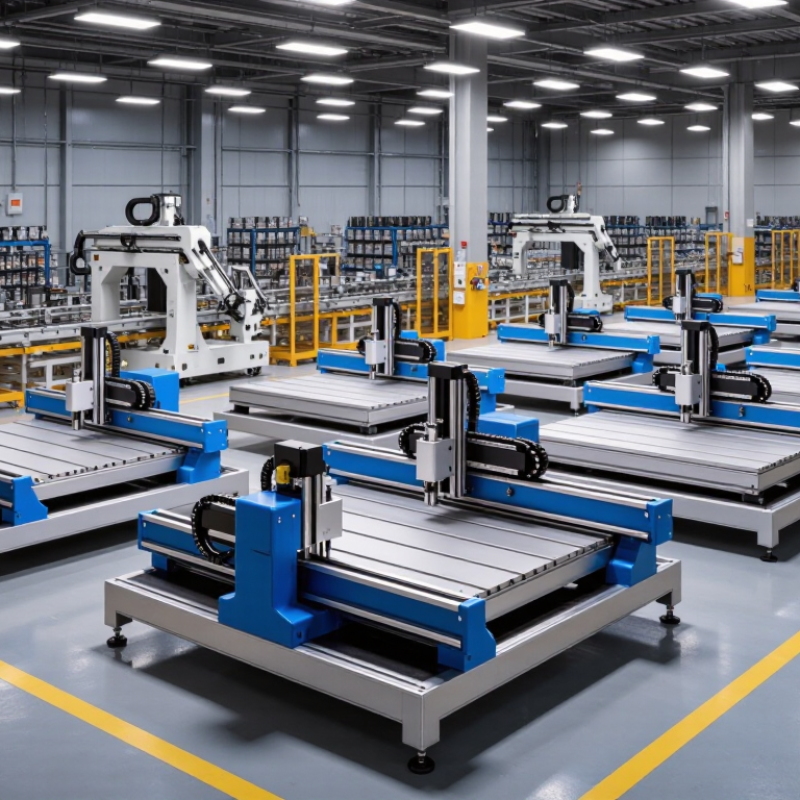
An XYZ axis assembly is a three-direction motion system used for positioning, inspection, cutting, dispensing, and automated handling. The X axis moves left and right. The Y axis travels forward and backward. The Z axis moves vertically. Together, these axes create controlled movement inside a defined workspace.

Each axis normally includes a motor, linear guide, drive mechanism, and mounting structure.

Ball screws support accurate movement under heavier loads. Timing belts can provide faster travel at lower cost.

Encoders measure position and send feedback to the controller. The controller then adjusts motor movement when the actual position differs from the programmed position.

The International Federation of Robotics reported 541,302 industrial robot installations worldwide in 2023, a 10% annual increase. This expansion increases demand for reliable motion assemblies. Industry motion-control reports also identify accuracy, repeatability, speed, and integration as key purchasing factors. These terms are not interchangeable. A system may be accurate but slow, or fast but less repeatable.

A useful inspection starts with payload, travel distance, acceleration, cycle time, and environmental conditions. Field engineers should also check cable drag, lubrication access, and thermal expansion. Small details matter. A poorly supported cable can reduce service life. An oversized motor may create unnecessary vibration and energy use. Specifications can look complete, yet real production conditions often expose gaps.

Key Specifications for Evaluating XYZ Axis Assembly Suppliers

For global buyers, an XYZ axis assembly supplier should be judged by measurable specifications, not attractive photographs. The International Federation of Robotics’ World Robotics 2024 report recorded 541,302 industrial robot installations worldwide in 2023. That scale increases pressure on motion suppliers.

Start with payload, stroke, speed, acceleration, and repeatability. Ask for test conditions. A repeatability value without temperature, load, and travel direction is incomplete. Linear accuracy, straightness, backlash, encoder resolution, and thermal drift also deserve attention. ISO 230 and ISO 9283 references can make supplier comparisons more reliable.

Energy use matters too. The U.S. Department of Energy’s Industrial Decarbonization Roadmap identifies motor-driven systems as consuming roughly 70% of industrial electricity. Efficient motors, correct sizing, and low-friction guides can reduce operating costs. Small details matter.

In supplier audits, request calibration certificates, lifetime-test records, bearing specifications, and traceable inspection data. Confirm whether the assembly survives continuous duty, dust, vibration, and repeated emergency stops. Ask about replacement lead times and firmware support. A polished sample is not enough.

I would also challenge unusually precise claims. They may be valid, or merely optimistic. Require a witnessed factory acceptance test, including actual payload and cycle time. Check conformity documentation for the destination market, electrical ratings, guarding, and machine integration. The best supplier is not always the fastest or cheapest. It is the one that proves performance under your conditions.

2026 Best XYZ Axis Assembly Suppliers for Global Buyers

Key Specifications for Evaluating XYZ Axis Assembly Suppliers

Specification Representative Lower Benchmark Representative Upper Benchmark Why It Matters
X/Y Travel 100 mm 300 mm Defines the usable planar working envelope.
Z Travel 50 mm 150 mm Determines vertical reach and tooling clearance.
Repeatability 0.5 µm 5 µm Indicates how consistently the assembly returns to a position.
Maximum Speed 100 mm/s 500 mm/s Affects cycle time and production throughput.
Vertical Load Capacity 5 kg 50 kg Confirms suitability for the payload and tooling assembly.

The chart presents representative industrial benchmark ranges rather than company-specific performance claims. Global buyers should verify travel accuracy, repeatability measurement conditions, payload orientation, speed under load, environmental limits, controls compatibility, documentation, and after-sales support before selecting an XYZ axis assembly supplier.

Top Supplier Categories for Global XYZ Axis Assembly Buyers

Global XYZ axis assembly buyers usually compare five supplier categories. Integrated automation manufacturers offer complete stages, motors, controllers, and safety interfaces. They suit production lines needing one technical contact. Precision motion specialists focus on repeatability, low backlash, and smooth travel. Their assemblies often support inspection, dispensing, and laboratory equipment. Custom engineering workshops build around unusual loads, limited spaces, or special mounting patterns. This flexibility can increase development time.

Regional distributors provide stocked components, application advice, and faster replacement support. They are useful when downtime costs more than a small price difference. Contract assemblers combine purchased rails, drives, cabling, and frames into tested modules. This option helps buyers lacking internal integration staff. Not every category fits every project.

Experienced buyers should request measured data, not only catalog ratings. Check positional accuracy, repeatability, payload, stroke length, acceleration, and duty cycle. Ask how testing is performed. A supplier should provide inspection records, assembly drawings, wiring details, and maintenance guidance. Clear documentation shows professional control.

Service quality matters after delivery. Confirm spare-part availability, remote troubleshooting, repair procedures, and training options. For clean environments, verify materials, lubrication, sealing, and particle-control practices. For global projects, review packaging, export documents, voltage compatibility, and local support coverage. A polished datasheet is not proof of stable performance. Pilot testing remains wise, even with an impressive supplier history. In practice, a slightly slower assembly may outperform a faster one with cable drag or poor alignment. Mistakes happen. Reliable suppliers explain them, correct them, and improve the process.

Manufacturing Quality, Customization, and Compliance Standards

2026 Best XYZ Axis Assembly Suppliers for Global Buyers?

Manufacturing quality begins with measurable evidence, not attractive specifications. The International Federation of Robotics reported 541,302 industrial robot installations in 2023, increasing demand for precise, repeatable motion systems. Buyers should request backlash, straightness, repeatability, and load-test results for each axis. CMM inspection reports and serial-number traceability make these claims easier to verify. Small details matter. Cable chains should move smoothly, while bearings need protection from dust and cutting debris.

Customization should match the application, not merely extend the catalog. Suppliers should calculate payload, stroke, acceleration, duty cycle, and thermal expansion together. A laboratory gantry may require sub-millimeter repeatability, while a packaging line may prioritize speed and washdown resistance. According to the ISO Survey 2022, more than 1.26 million ISO 9001 certificates were reported worldwide. Certification helps, but it does not replace process audits, sample testing, or documented corrective actions. Real experience often reveals gaps between factory promises and production behavior.

Compliance also requires market-specific documentation. ISO 12100 risk assessment, IEC 60204-1 electrical safety, and applicable RoHS or REACH declarations should accompany the assembly. Ask for material certificates, inspection records, and a clear change-control process. FAT results are useful. They are not the whole story. A weakness remains: many buyers compare unit prices before evaluating downtime, spare-part access, and calibration support. That choice can create avoidable costs after installation.

How to Select and Compare the Best Supplier for Your Application

Selecting an XYZ-axis assembly supplier starts with the application, not the catalog. Define payload, stroke, speed, duty cycle, and required repeatability. A 600 mm axis moving a camera differs greatly from one carrying a cutting head. According to World Robotics 2024, 541,302 industrial robots were installed globally in 2023. This growth increases demand for compact, reliable motion systems. It also creates more supplier noise.

Ask each supplier for measured accuracy data, not only brochure ratings. ISO 230-2 supports a consistent method for positioning accuracy and repeatability tests. ISO 9283 is also useful when the assembly operates within a robotic cell. Request test conditions, load position, temperature, lubrication interval, and sample size. Compare lead time, spare-part access, integration support, and documented quality controls. A low quotation can hide costly commissioning work. I have seen technically strong assemblies fail because cable routing was treated as an afterthought. That is an uncomfortable but common lesson.

Tips: Build a weighted comparison sheet. Give separate scores for motion performance, service response, documentation, and total cost. Ask for a sample inspection report and a video under load. Check whether the supplier can reproduce your working cycle. Do not accept “customizable” as proof of capability. Run a small pilot when tolerances are tight. Your first specification may be wrong; field testing should be allowed to challenge it.

2026 Best Xyz Axis Assembly Suppliers for Global Buyers? - How to Select and Compare the Best Supplier for Your Application
Anonymous supplier capability profiles for preliminary global sourcing and application matching
Supplier Profile Typical Assembly Type Common Travel Range Typical Payload per Axis Typical Repeatability Typical Maximum Speed Drive Technology Recommended Application Key Strength Main Trade-Off Buyer Verification Priority
Profile A — Precision Micro Compact Cartesian XYZ stage 25–150 mm 0.5–3 kg ±0.5–2 µm 50–250 mm/s Ball screw or precision lead screw with servo/stepper motor Optical inspection, laboratory automation, micro-positioning High positioning precision Lower payload and slower throughput than production-focused designs Calibration method, encoder resolution, thermal drift, and measured—not theoretical—repeatability
Profile B — Balanced Industrial Modular linear-axis XYZ assembly 100–600 mm 3–15 kg ±2–10 µm 100–600 mm/s Ball screw or belt drive with servo motor General automation, dispensing, inspection, light assembly Best performance balance May require application-specific tuning and guarding Duty cycle, acceleration, backlash, cable management, and controller compatibility
Profile C — High-Speed Handling Belt-driven Cartesian robot 300–2,000 mm 2–20 kg ±10–50 µm 500–2,000 mm/s Timing belt with servo motor Pick-and-place, packaging, transfer lines, high-cycle handling High throughput Lower stiffness and precision than ball-screw assemblies at long travel Acceleration profile, belt tension, vibration, positioning under load, and cycle-time test results
Profile D — Heavy-Duty Linear Reinforced Cartesian XYZ gantry 300–3,000 mm 15–100 kg ±10–75 µm 100–800 mm/s Rack-and-pinion, ball screw, or heavy-duty belt drive Machine tending, palletizing assistance, welding, large-part processing High load capacity Larger footprint, higher installation cost, and greater moving mass Frame stiffness, bearing life, structural deflection, emergency stopping, and foundation requirements
Profile E — Cleanroom-Compatible Enclosed or low-particle XYZ stage 50–800 mm 1–15 kg ±1–15 µm 50–500 mm/s Sealed ball screw or linear motor Semiconductor support equipment, medical devices, laboratory production Controlled-environment suitability Higher cost and more demanding maintenance procedures Cleanroom class, particle testing standard, outgassing, lubrication, seals, and material compatibility
Profile F — Cost-Optimized Standard Pre-engineered aluminum-profile XYZ module 100–1,500 mm 1–10 kg ±20–100 µm 100–1,000 mm/s Belt or lead screw with stepper motor Educational equipment, basic dispensing, non-critical automation Short lead time and low initial cost Limited customization, lower stiffness, and wider performance variation Actual load-speed curve, spare-parts availability, assembly quality, and acceptance testing
Profile G — Integrated Turnkey Complete XYZ system with controller and software 100–2,000 mm 2–50 kg ±5–50 µm 100–1,500 mm/s Servo-driven ball screw, belt, rack, or linear motor Production cells requiring rapid deployment and coordinated motion Single-point system integration Less flexibility if proprietary controls or interfaces are used Open communication protocols, software ownership, remote support, FAT/SAT scope, and lifecycle cost
Data basis: The ranges above are non-branded market-screening benchmarks commonly found in standard XYZ linear-stage and Cartesian-gantry specifications. Actual performance depends on travel length, payload position, acceleration, mounting orientation, duty cycle, environmental conditions, tuning, and measurement method. Request a signed datasheet, application test, dimensional drawing, warranty terms, and acceptance criteria before placing an order.