China Best EV Charging Station Suppliers for Global Buyers
Choosing reliable China Ev Charging suppliers requires more than comparing factory prices. Global buyers must examine engineering depth, product consistency, certifications, and long-term service support. A charger may look impressive in a showroom, yet fail beside a dusty highway or a crowded apartment garage. That gap matters.
Zhang Yongwei, vice chairman and secretary-general of China EV100, has said, “Charging infrastructure should develop moderately ahead of new-energy vehicles.” His observation reflects a practical challenge. Demand is growing quickly, but deployment quality remains uneven. Strong suppliers understand this reality. They test power modules, connectors, payment systems, thermal performance, and remote monitoring before shipment. They also provide clear installation documents and replacement procedures.
This guide introduces leading Chinese suppliers for global buyers. It considers AC wall boxes, DC fast chargers, liquid-cooled systems, portable units, and charging-network software. Attention is given to output ranges, communication standards, warranty terms, factory audits, and after-sales response. Field experience matters here. A 22 kW charger in a hotel car park has different needs from a 480 kW unit at a logistics depot.
Not every supplier fits every market.
Some companies communicate well but offer weak technical documentation. Others build excellent hardware but respond slowly after delivery. Buyers should question both strengths and omissions. Local grid conditions, climate, payment habits, and maintenance skills can change the final result. The best China Ev Charging partner is not always the largest manufacturer. It is the supplier that can prove performance, explain limitations, and improve when problems appear.
What Defines a Reliable EV Charging Station Supplier in China
For global buyers, a reliable Chinese EV charging station supplier is more than a low quotation. It must prove performance under heat, dust, voltage fluctuation, and heavy daily use.
The IEA’s Global EV Outlook 2024 reports that public charging points worldwide exceeded four million in 2023. China held the largest share. The China Electric Vehicle Charging Infrastructure Promotion Alliance recorded about 2.73 million public charging piles in China by the end of 2023. Scale raises the cost of failure.
During supplier audits, I look for traceable component records, calibrated end-of-line tests, and field repair data. Evidence matters. A supplier should disclose efficiency, thermal derating, ingress protection, insulation testing, and failure rates. Its software should support secure updates, load management, and open communication protocols.
OCPP 2.0.1 offers a useful interoperability benchmark. Still, protocol support alone proves little. Test the charger with your backend and vehicle models.
After-sales capability often separates dependable suppliers from temporary exporters. Look for regional spare-parts planning, multilingual manuals, remote diagnostics, and a clear replacement process.
IEC 61851 compliance is important, but certificates cannot replace operational evidence. No factory is perfect. A polished production line may still hide weak field data.
Request raw service records, sample test reports, and customer-site references. Ask difficult questions. Reliable suppliers usually answer with numbers, not promises.
Main Types of EV Charging Stations Offered by Chinese Manufacturers
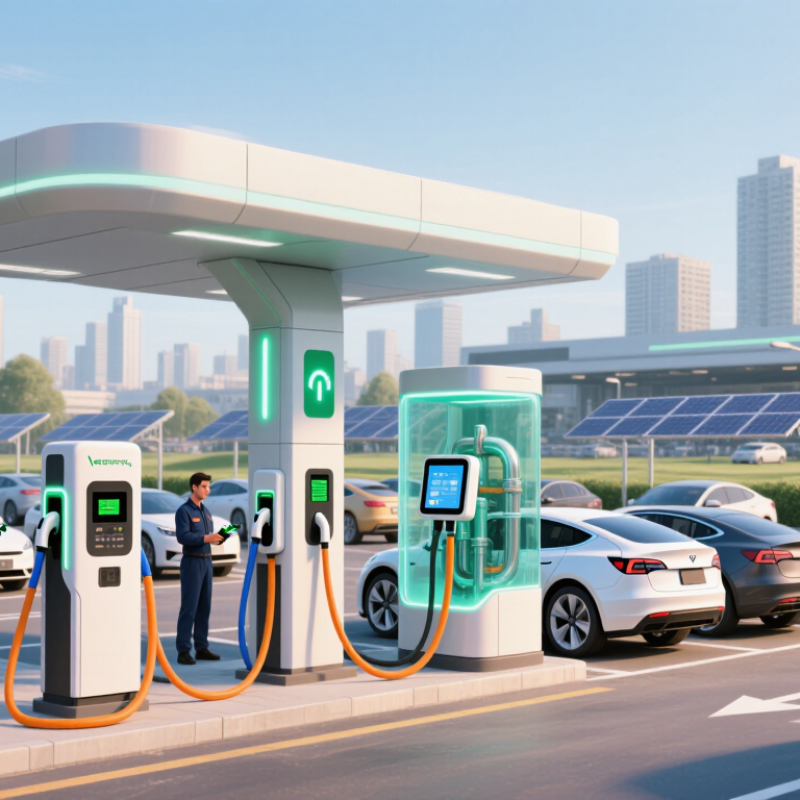
Chinese manufacturers offer several EV charging station types for global buyers, each serving a different charging environment. AC wallbox chargers commonly support homes, offices, hotels, and apartment parking areas. They usually deliver 7 kW to 22 kW, depending on the electrical system and vehicle compatibility. Their compact housings often include RFID access, mobile monitoring, load balancing, and scheduled charging. Installation is usually simple. However, cable quality and thermal protection deserve close inspection.
DC fast chargers suit highways, fleet depots, shopping centers, and busy urban sites. Typical output ranges from 20 kW to over 360 kW. Larger units may support multiple vehicles simultaneously, but they require stronger grid connections and careful heat management. Air-cooled designs can reduce maintenance complexity, while liquid-cooled systems may support higher power. Portable chargers provide flexibility for roadside use, temporary projects, or low-density regions. They are useful, but their power output remains limited.
Some suppliers also produce split-type systems, where the power cabinet sits away from the charging dispenser. This arrangement can reduce visual clutter and simplify future expansion. Global buyers should review IEC 61851 compatibility, OCPP support, ingress protection, connector options, warranty terms, and factory testing records. A low quotation can hide weak software or expensive spare parts. Not every test report proves long-term reliability. Site trials, sample inspections, and clear after-sales procedures still matter. The careful choice is rarely the cheapest one.
Key Standards and Certifications for Global EV Charging Equipment
China Best EV Charging Station Suppliers for Global Buyers
Global buyers should evaluate charging equipment against the destination market, not only the factory specification sheet. IEC 61851 addresses conductive charging control and safety. IEC 62196 covers plugs, sockets, and vehicle connectors. These standards help confirm whether a charger can communicate and connect safely.
For networked equipment, ISO 15118 may support vehicle identification, charging control, and future smart-charging functions. OCPP compatibility can improve communication with different backend platforms. However, protocol support should be verified through test records, not sales language. The label is not enough. Test evidence matters.
Market access also requires regional conformity work. CE marking applies to relevant European requirements, while UKCA may apply in Great Britain. North American projects often require recognized electrical safety certification and electromagnetic compatibility testing. Check enclosure ratings, residual-current protection, cable temperature limits, and emergency stop behavior. A practical inspection should compare certificates with the exact model, firmware, connector type, and input voltage. Mismatched documents are common. They can delay installation.
Ask suppliers for factory inspection records, laboratory reports, calibration details, and sample test results. Review protection performance at outdoor sites with rain, dust, freezing temperatures, or heavy vehicle traffic. A charger passing a laboratory test may still need better cable management or clearer maintenance instructions. That gap deserves honest discussion before purchase.
How to Evaluate Chinese EV Charging Station Suppliers
Choosing Chinese EV charging station suppliers requires more than comparing factory prices. The IEA’s Global EV Outlook 2024 reported over four million public charging points worldwide by the end of 2023. China represented the largest share of this infrastructure. That scale shows manufacturing strength, but it does not guarantee field reliability. Ask suppliers for audited production records, failure rates, warranty terms, and recent export references. Request test reports for IEC 61851, electromagnetic compatibility, ingress protection, and electrical safety. Certificates should match your target market, not merely decorate a sales presentation.
Evaluate software as carefully as hardware. Confirm support for OCPP 1.6J or OCPP 2.0.1, remote diagnostics, load balancing, and secure firmware updates. The U.S. National Renewable Energy Laboratory has highlighted interoperability and uptime as important factors in charging-network performance. Therefore, request a written uptime service-level agreement and a sample dashboard. Test a pilot unit in heat, rain, and unstable grid conditions. Laboratory success can still disappoint.
Tips: Compare total cost over five years, including installation, spare parts, software, and technician visits. Inspect cable cooling, connector durability, emergency-stop access, and screen visibility under direct sunlight. Ask who owns charging data. Also, do not trust unusually low quotations without checking component traceability. I have seen technically strong samples fail during deployment because local maintenance was overlooked. That is an uncomfortable lesson. A supplier’s response speed after installation may reveal more than its factory tour.
Export, Installation, and After-Sales Support for International Buyers
China Best EV Charging Station Suppliers for Global Buyers
For international buyers, export capability means more than loading chargers into a container. The International Energy Agency reported nearly 14 million electric car sales worldwide in 2023. It also recorded more than four million public charging points globally. This growth increases pressure on suppliers to provide tested hardware, accurate documents, and dependable installation guidance.
Experienced Chinese suppliers should support voltage checks, connector selection, grid assessment, and local certification before shipment. A practical export package includes wiring diagrams, multilingual manuals, spare-part lists, and factory test records. Installation teams should explain cable routing, grounding, network configuration, and emergency procedures. Remote commissioning can reduce travel costs, but it is not always enough. Site conditions can defeat a perfect drawing.
After-sales support deserves clear service levels. Buyers should request response times, diagnostic procedures, firmware policies, and replacement-part availability in writing. The IEA’s Global EV Outlook 2024 notes that China held about two-thirds of the world’s public charging stock in 2023. That manufacturing experience is valuable, but production scale does not guarantee local service quality. Suppliers should train regional technicians and keep critical parts near operating sites. Some projects still fail quietly. A delayed controller or unclear fault code can stop a busy depot for hours. Buyers should also review warranty exclusions, language support, and remote monitoring data before signing. These details are less visible than charger power, yet they often decide long-term reliability.