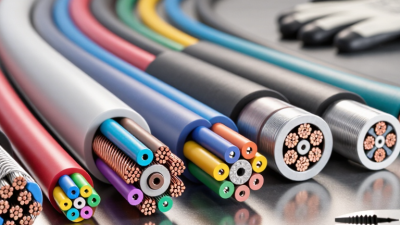
How to Choose the Right Power Cable for Your Needs?
Choosing a Power Cable is not just a matter of matching the plug. The right choice depends on the equipment’s power demand, cable length, installation route, and surrounding conditions. A cable running behind a desk faces different demands from one used outdoors or beside warm machinery. Small details matter.
Power cable specialist Jordan Lee puts the guiding principle this way: “Match the cable to the load, the route, and the environment—not just the connector.” Use that as a starting point, not a substitute for checking the equipment label and the cable’s specifications. Look at current and voltage ratings, conductor size, insulation, connector fit, and whether the cable is rated for heat, moisture, or abrasion. A long run can also affect performance. The label may look reassuring, yet still fail to answer every practical question.
This guide will walk through those checks in plain terms, then show how to compare cables for home, office, and equipment use. It will explain when flexibility matters, why a neat-looking cable may be unsuitable, and what signs call for replacement. Some choices seem obvious until the cable gets warm, bends sharply behind a cabinet, or reaches a damp workspace. I have seen people focus on price and overlook the route; it is an easy mistake, and worth reconsidering. When ratings or installation requirements are unclear, consult a qualified electrician or the equipment manufacturer. Better to pause than guess.

Determine the Electrical Requirements of Your Equipment
Start with the equipment nameplate, not the cable already in the drawer. Record its voltage, phase, frequency, and rated current; check the manual for startup current or special duty requirements. A motor can draw more current while starting than it uses during steady operation. The U.S. Department of Energy’s 2014 Improving Motor and Drive System Performance sourcebook reports that motor-driven systems account for about 68% of electricity use in U.S. manufacturing. That figure does not specify a cable size, but it shows why motor loads deserve careful attention. Numbers matter.
Match the cable’s current rating to the equipment and its installation conditions. Longer runs can increase voltage drop, while heat, bundling, or a damp location may affect the cable type and rating. Check that the plug and connector ratings also suit the load; a heavy-duty cable does not compensate for an underrated connector. It is tempting to stop at amperage. I would not. Compare the nameplate with the manufacturer’s instructions and applicable electrical standards, and ask a qualified electrician when the ratings or installation conditions are unclear. A quick check is less exciting than replacing a warm, undersized cable. It is also wiser.
Compare Power Cable Types and Connector Options
Power cables differ in more than appearance. A common C13-to-C14 cord suits many desktop computers and monitors, while a C5 connector, often called a cloverleaf, fits some laptop power supplies. Smaller devices may use a C7 figure-eight connector. Higher-power equipment can require a C19 connector. Check the equipment inlet before ordering; similar-looking connectors may not fit.
Connector shape is only part of the choice. The cable’s current rating, wire gauge, insulation, and length must suit the device and power source. A longer cord can cause more voltage drop, especially when it is undersized for the load. Read the device label and cable markings. Don’t guess.
The wall plug also varies by region, so confirm that it matches the outlet. A snug connection matters. If a plug wobbles, feels unusually warm, or needs force, stop using it and inspect the fit. It is easy to focus on connector names and overlook the rating printed on the jacket. I still find that detail worth checking twice.
Choose the Correct Wire Gauge and Cable Length
How to Choose the Right Power Cable for Your Needs?
Choose the Correct Wire Gauge and Cable Length
Wire gauge and cable length work together. A thinner conductor or a longer run increases resistance, creating voltage drop and heat. Match the gauge to the load current, cable material, insulation rating, and installation conditions. Bundled cables, warm spaces, and enclosed conduits can reduce how much current a cable safely carries. Check the applicable ampacity tables before choosing.
Length matters. IEC 60228:2004 lists a maximum resistance of 7.41 ohms per kilometre for a 2.5 mm² copper conductor at 20°C. For a 30-metre one-way run, the outgoing and return conductors total 60 metres. At 10 amps, their estimated resistive voltage drop is about 4.4 volts. That is a useful warning, not a complete design calculation: operating temperature, connectors, and AC effects can change the result.
Use a voltage-drop calculator or consult a qualified electrician for demanding or long runs. The U.S. National Electrical Code’s informational notes in Sections 210.19(A)(1) and 215.2(A)(1) recommend keeping voltage drop within 3% for a branch circuit and 5% overall. These are recommendations, not universal guarantees. Measure the actual route, including bends and slack. I’ve seen people measure only the straight-line distance. It often comes up short.
How to Choose the Right Power Cable for Your Needs?
Choose the Correct Wire Gauge and Cable Length
For a 12 V DC circuit carrying 10 A, this chart estimates the maximum one-way cable length that keeps voltage drop at or below 3% (0.36 V). Estimates use copper wire resistance at 20°C; longer runs or higher currents may require a thicker cable. Check applicable electrical codes and the cable manufacturer's specifications before installation.
Assess Installation Conditions and Environmental Needs
A cable that works well in a dry plant room may overheat in a crowded conduit or fail early outdoors. Check the route before selecting its insulation and jacket. Note ambient temperature, sunlight, moisture, chemicals, vibration, and whether the cable will be buried or enclosed. A tidy drawing can still hide a hot, damp trench.
For buried runs, soil temperature and thermal resistivity affect how quickly heat leaves the cable. Grouped cables and long conduit sections can also reduce current capacity. The IEC 60287 series calculates cable current ratings using factors such as installation method and thermal conditions. Use the cable maker’s technical data, and have a qualified electrical professional verify the design. Small details matter. A nearby pump may add heat and vibration that a basic load estimate misses.
The scale of grid work makes durable installation choices important. The International Energy Agency’s 2023 report, Electricity Grids and Secure Energy Transitions, estimates that 80 million kilometres of grids must be added or refurbished by 2040. That figure concerns grids, not cable alone, but it highlights the long service life expected of infrastructure. Match the cable to its actual exposure, not an idealized route. I still find temperature assumptions easy to underestimate; record them and revisit them when site conditions change.
| How to Choose the Right Power Cable for Your Needs? — Assess Installation Conditions and Environmental Needs | ||||
|---|---|---|---|---|
| Installation Condition | Environmental Concern | Cable Features to Check | Typical Consideration | Before Installation |
| Indoor, dry, fixed installation | Low exposure to moisture, sunlight, and mechanical damage | Conductor size, insulation voltage rating, temperature rating, and applicable building-code approval | A cable listed for the intended indoor wiring method may be suitable; requirements vary by location and use. | Confirm the circuit load, installation method, and local electrical-code requirements. |
| Outdoor or exposed installation | Rain, sunlight, temperature changes, and possible physical impact | Outdoor or wet-location suitability, UV resistance where exposed to sunlight, and appropriate mechanical protection | Use a cable specifically marked or listed for the actual exposure; an indoor-only cable should not be assumed suitable outdoors. | Check the cable marking, enclosure entries, connectors, and protection against damage. |
| Underground installation | Soil moisture, water ingress, soil conditions, and impact during backfill | Approval for direct burial or installation in a suitable conduit, water resistance, and required protective covering | Direct-burial suitability and burial depth requirements depend on the cable type and local electrical rules. | Verify permitted burial method and depth with applicable code; use suitable conduit or other protection where required. |
| High-temperature area | Heat from equipment, hot pipes, engines, or enclosed spaces | Insulation temperature rating, conductor ampacity at the actual temperature, and proximity limits | Allowable current can be reduced at elevated ambient temperatures and when multiple cables are grouped. | Use the installation temperature and grouping conditions when checking ampacity and derating requirements. |
| Exposure to oils, fuels, or chemicals | Insulation or sheath degradation from contact with specific substances | Documented chemical compatibility of the cable jacket and insulation | Resistance to one chemical does not guarantee resistance to another; compatibility depends on substance, concentration, and exposure time. | Identify the exact chemical and consult cable compatibility data from a qualified technical source. |
| Repeated movement or vibration | Conductor fatigue, abrasion, and strain at connection points | Suitability for flexing, conductor stranding, bend radius, abrasion resistance, and strain relief | A cable intended for fixed wiring may not be suitable for continuous movement. | Check the required flexing duty, movement path, bend radius, and connector strain relief. |
| Installation near sensitive signal or control wiring | Electrical noise and electromagnetic interference | Shielding where needed, correct grounding and bonding, and separation from power cables | Shielding can help in some applications but does not replace correct routing and installation practices. | Follow equipment instructions and local rules for cable separation, shield termination, and grounding. |
Check Safety Ratings, Certifications, and Compatibility
Safety labels are not decoration. Check the cable’s rated voltage, current, temperature, and intended use against the equipment documentation. A plug that fits does not prove electrical compatibility. The uncomfortable part: appearance can be misleading. Look for certification from an independent testing body recognized in your region, and verify that the marking applies to the cable’s actual use. Requirements differ for household appliances, outdoor equipment, and fixed wiring. Don’t treat them as interchangeable.
Compatibility also depends on conductor size, cable length, and the environment. A long, undersized cable can lose voltage and heat up under load; damp areas or hot machinery need suitable insulation and ratings. Check the plug type, supply voltage, frequency, and appliance current before buying. If any rating is missing or unclear, pause and ask a qualified electrician. This step is easy to rush. The risk is real: NFPA’s Home Electrical Fires analysis, based on 2015–2019 U.S. data, estimated an annual average of 31,647 home fires involving electrical failures or malfunctions, with 430 deaths and $1.3 billion in direct property damage. That report does not mean every cable choice causes a fire, but it supports careful checks. Keep the label or product documentation for later reference.
Related Posts
-
10 Tips to Choose the Right Electrical Power Cable
-
Why Is Power Cable Quality Important for Global Buyers?
-

2026 Top Electrical Power Cable Suppliers for Global Buyers
-
China Best Power Cable Electrical Manufacturers?
-
Discovering the Best Voltage Cable Options for Your Electrical Projects
-
Top 10 Power Cable Suppliers in China for Global Buyers?