
What Is an EV Power Station and How Does It Work?
An Ev Power Station stores electricity and delivers it to an electric vehicle when charging is needed. Unlike a fuel pump, it transfers energy through charging equipment, often called EV supply equipment, or EVSE. The station may draw power from the grid, solar panels, or a built-in battery. Some systems combine all three. The terminology is not always tidy, so product specifications matter.
Inside a battery-based unit, stored direct current passes through power electronics that manage voltage and current. An inverter converts electricity when the design requires it. A compatible charging connector then links the equipment to the vehicle, while control systems help regulate the session. Simple in principle. Real-world results vary. Charging speed depends on the station’s output, the vehicle’s onboard charger, battery temperature, and the cable or connector used. Energy is also lost during conversion, so the charge delivered to a car may be lower than the amount drawn from storage.
Picture a unit beside a garage, with a thick charging cable and a display showing remaining capacity. It can provide backup charging where grid access is limited, but a compact power station may add only modest range. It is not automatically a replacement for a permanent home charger or a public fast-charging site. Check connector compatibility, rated output, usable capacity, and manufacturer guidance before relying on one. For fixed wiring or high-power equipment, professional installation and inspection may be necessary. A useful comparison starts with the vehicle’s charging limits, not the biggest number on a product label. The details deserve a second look.
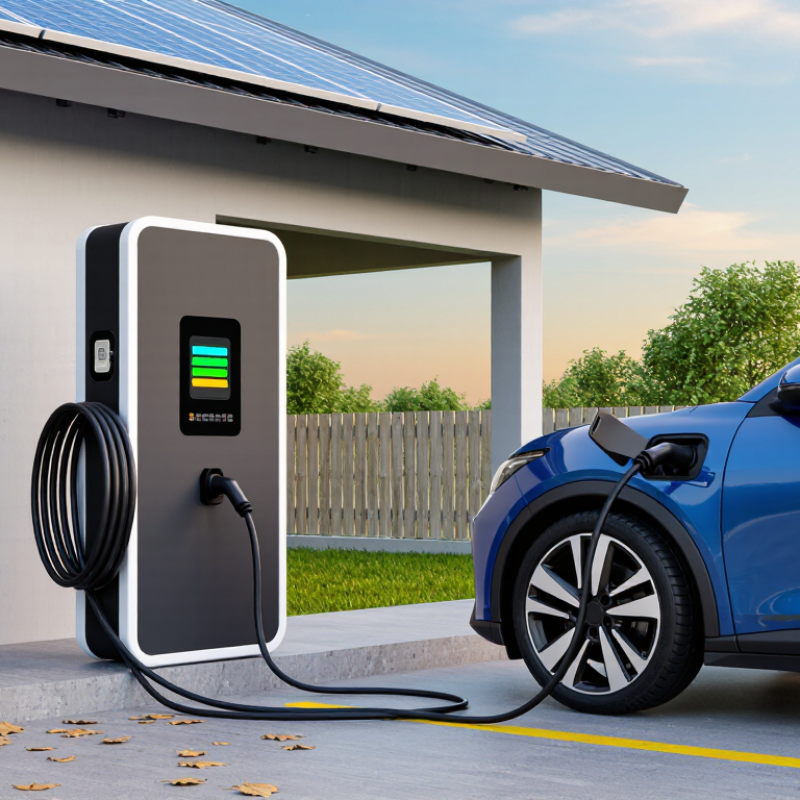
What an EV Power Station Is and What It Does
An EV power station is equipment that supplies electricity to charge an electric vehicle. The term can describe a home charger, a public charging unit, or a larger system paired with battery storage. It is not the vehicle’s battery. Its job is to deliver power safely and communicate with the car while charging. Some units draw electricity directly from the grid; others can also store energy for later use. The wording can be confusing, since these systems vary in size and purpose.
At home, a wall-mounted unit may charge a car overnight, while a roadside station is designed for quicker stops. With AC charging, the vehicle usually converts incoming power for its battery. A DC fast charger performs that conversion within the charger itself. Small distinction. A station does not decide the final charging speed alone: the vehicle’s limits, the unit’s output, and battery temperature all matter. For example, a car connected to a high-output charger may still charge more slowly when its battery is cold. Check connector compatibility and rated output before choosing equipment. Real conditions are less tidy than a specification sheet.
The Main Components Inside an EV Power Station
A high-power EV power station contains several systems working together behind its charging cables. The exact layout varies, but most DC stations include switchgear, a transformer, power-conversion modules, control equipment, and cooling. Incoming electricity passes through switchgear, which helps isolate equipment during faults or maintenance. A transformer adjusts voltage to suit the station’s design. Power-conversion modules then change alternating current into direct current for the vehicle’s battery. That distinction matters.
Some stations also include battery storage to support demand during busy periods or where grid capacity is limited. It is not a standard feature everywhere. After conversion, a shared DC bus can distribute power to multiple charging dispensers. Control units manage charging levels and communicate with the vehicle. Sensors monitor current, voltage, and temperature, while protective systems can stop power if readings fall outside safe limits. Cooling keeps electronics and, in some designs, charging cables from overheating. Heat is easy to underestimate. Metering records energy delivered, helping operators track station performance. There is no single arrangement: capacity, site conditions, and equipment design all affect what sits inside. A neat diagram can make the system look simpler than real installations are.
How Electricity Reaches the Station and the Vehicle
An EV power station is a small electrical system connected to the local grid. Electricity travels through distribution lines to the site, where a transformer adjusts voltage for the equipment. Switchgear and protective devices help manage faults and isolate circuits. From there, power flows to individual charging units. The route is not always simple. Older sites may need upgrades before adding fast chargers.
The International Energy Agency’s Global EV Outlook 2024 reported more than four million public charging points worldwide in 2023, with installations rising nearly 40% from 2022. At the vehicle, the process depends on the charger type. An AC unit sends alternating current to the car, whose onboard charger converts it for the battery. A DC fast charger performs that conversion at the station and delivers direct current to the battery. The car and charger exchange signals to check battery limits and adjust power. Site software can also share available capacity among several vehicles. Useful, but not magic. A crowded site may reduce charging speed when several cars draw power together. I still find the quiet details—cable temperature, connection quality, and changing demand—easy to underestimate.
How an EV Power Station Charges an Electric Vehicle
An EV power station controls the flow of electricity between the grid and an electric vehicle. After the cable clicks into place, the station and vehicle exchange information and check that charging can begin safely. The vehicle’s battery management system then helps regulate the power it receives.
With AC charging, the station supplies alternating current, which the vehicle’s onboard charger converts into battery-ready direct current. With DC fast charging, conversion happens inside the station, so power reaches the battery directly. Charging speed depends on the station, the vehicle, battery temperature, and its current charge level. Near full, charging usually slows. The process is controlled. A cold battery or busy site can make the wait longer than expected.
The International Energy Agency’s Global EV Outlook 2024 reports nearly four million public charging points worldwide in 2023, about 40% more than the year before. Its report also notes that fast-charger numbers grew by around 55%. These figures show why reliable communication and power management matter at busy charging sites. Still, peak charging rates can be misleading: a car may briefly reach its advertised maximum, not hold it throughout a session. Sources: IEA, Global EV Outlook 2024; U.S. Department of Energy, Alternative Fuels Data Center.
Common Station Types, Charging Speeds, and Safety Features
An EV power station may mean a public charging point or a larger site with several chargers. Common options include Level 1, Level 2, and DC fast charging. Level 1 uses a standard household outlet and is slow, often adding only a few miles of range per hour. Level 2 uses AC power and suits homes, workplaces, and parking areas. DC fast stations convert power within the station, so they can charge compatible vehicles much faster.
Numbers need context. Level 2 units often deliver around 7–19 kW, while DC fast chargers may provide 50 kW or more. Actual charging speed depends on the vehicle, battery temperature, and charge level. A cold battery may charge slowly. So can a nearly full one. A station’s maximum rating is not a promise of the speed every car will receive.
Safety features help manage heat and electrical faults. Many stations monitor current, detect ground faults, and stop power if a problem occurs. Connectors may lock during charging, while weather-resistant housings protect equipment outdoors. Users should check cables for cuts or exposed wires and avoid using damaged connectors. A quick visual check is easy. It is not a complete inspection, but it can catch obvious trouble.
What Is an EV Power Station and How Does It Work? - Common Station Types, Charging Speeds, and Safety Features
| Category | Type or Feature | Typical Power or Operation | How It Works | Practical Notes |
|---|---|---|---|---|
| Common EV Charging Station Types | ||||
| AC charging | Level 1 | Typically about 1.2–1.9 kW in North American household use | The station supplies AC electricity. The vehicle’s onboard charger converts it to DC to charge the battery. | Usually the slowest option; useful for overnight charging or low daily mileage. Charging speed depends on the vehicle and electrical supply. |
| AC charging | Level 2 | Commonly about 3.3–19.2 kW; many home units operate at lower or mid-range power | Like Level 1, it supplies AC power that is converted by the vehicle’s onboard charger. | Common at homes, workplaces, and public destinations. The vehicle’s onboard-charger limit may be lower than the station’s rated output. |
| DC charging | DC fast charging | Commonly about 50–350 kW, depending on the station and vehicle | The station converts grid AC to DC and supplies DC power to the battery through the vehicle’s charging system. | Often used for route charging. The vehicle controls the requested power, and charging commonly slows as the battery fills. |
| DC charging | High-power charging | At the upper end of DC fast charging, some installations can provide several hundred kilowatts per connector or shared power cabinet | Power electronics and station controls deliver DC within the limits agreed with the vehicle. | Only vehicles designed to accept high power can use it. Actual charging may be lower because of battery temperature, state of charge, or shared station capacity. |
| Charging Speed: What the Ratings Mean | ||||
| Speed measure | Station power rating | Measured in kilowatts (kW) | Indicates the station’s maximum rated power under specified conditions. | A higher rating does not guarantee a faster charge; the vehicle, battery, and site supply can limit delivered power. |
| Speed measure | Energy added | Measured in kilowatt-hours (kWh) | Charging power over time adds energy to the battery. For example, 10 kW sustained for one hour would deliver 10 kWh before losses. | Conversion losses and changes in charging power mean the energy added may differ from a simple maximum-power calculation. |
| Speed measure | Vehicle range added | Depends on vehicle efficiency; there is no single miles-per-hour figure for a station type | Range added depends on the energy delivered and how efficiently the vehicle uses that energy. | Weather, speed, terrain, vehicle model, and driving conditions all affect real-world range. |
| Speed measure | Charging curve and battery state | Power can change throughout a session | The vehicle and station communicate to adjust power. Many vehicles accept the highest power only during part of a DC charging session. | Charging from a low battery level is often faster than charging near full. Battery temperature and vehicle limits also matter. |
| Common Safety and Control Features | ||||
| Electrical protection | Ground-fault and overcurrent protection | Monitors for certain electrical faults and excessive current | Protective circuitry can interrupt power when a detected fault or unsafe current condition occurs. | Protection depends on the equipment and installation. Follow local electrical codes and manufacturer instructions. |
| Connection safety | Connector and cable monitoring | Checks connection status; some systems also monitor temperature | Charging is enabled only after the station and vehicle establish the required connection and communication. | Stop using damaged, unusually hot, or visibly worn charging equipment and report it to the operator. |
| Charging control | Communication and power limits | Power is negotiated between the station and vehicle | The system can adjust or stop charging based on vehicle requests, station limits, or detected conditions. | Charging behavior varies by vehicle and station; a power rating is a maximum, not a constant guarantee. |
| Emergency response | Emergency stop or power isolation | Availability and design vary by station | Some installations provide a clearly marked control or a means for authorized personnel to isolate power. | Use posted instructions in an emergency. Do not disconnect equipment that is damaged or sparking unless it is safe to do so. |
| Installation safety | Weather-rated enclosure and compliant installation | Equipment ratings vary by location and product | Enclosures and installation practices are selected for the intended indoor or outdoor environment. | Outdoor equipment should be installed and maintained according to its rating, local electrical rules, and the manufacturer’s guidance. |
Note: Power ranges are general examples, not guaranteed charging speeds. Actual results depend on the station, vehicle, battery condition and temperature, electrical supply, and charging-session conditions.