
How to Choose a Water Resistant Cable?
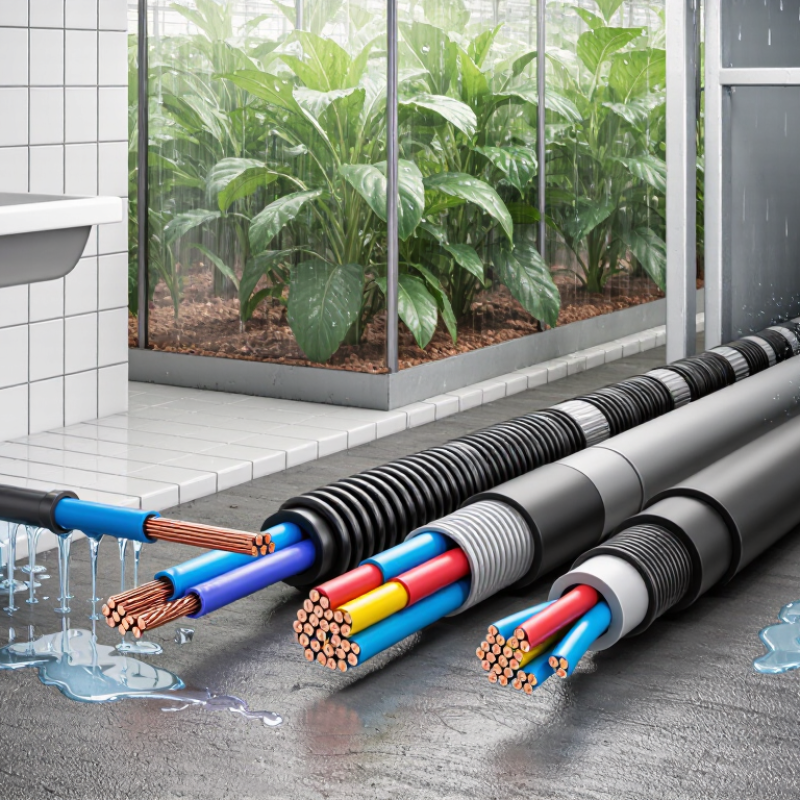
Choosing a Water Resistant Cable begins with the conditions it must face. Will it run beneath a damp sink, across a greenhouse, or beside equipment washed down each day? Those settings demand different levels of protection. Water resistance is not the same as waterproofing, and a product label alone cannot answer every question. Look for the cable’s documented ingress rating, approved environment, and installation limits.
For this draft, fictional cable-design engineer Daniel Reed offers a proposed line, not a verified quotation: “Choose for the water exposure, then check the entire installation—not just the cable jacket.” That distinction matters. Moisture can reach a system through a connector, splice, or damaged outer layer. A tough-looking black sheath is no guarantee. Small details count.
This guide explains how to compare cable construction, ratings, connectors, and environmental limits. It also considers temperature, sunlight, chemicals, movement, and installation method, because water is rarely the only stressor. Check manufacturer specifications rather than relying on vague claims such as “heavy duty.” Match the cable to the actual site, and leave room for maintenance and inspection. That sounds simple. It is not always. A rating may describe a specific test, not every real-world condition. The sections ahead offer practical checks for narrowing options and spotting unanswered questions before purchase. A careful choice starts with evidence, not appearance.
Understand Water-Resistance Ratings and Test Standards
A water-resistance rating is useful only when you know what was tested. In an IP code, the second digit describes protection from water; an “X” means that part of the code was not specified. IPX5 indicates resistance to water jets under defined test conditions. IPX7 covers temporary immersion, while IPX8 uses conditions stated for the specific product.
These ratings are not interchangeable. Numbers need context.
Check the test report, not just the label.
Was the complete cable assembly tested, including its connectors and seals, or only one component? Ask about water depth, exposure time, pressure, and whether the cable was bent or moved during testing. A static lab test may not reflect a cable dragged across a wet floor or flexed beside a machine.
Real use is messy. IEC 60529 defines IP protection tests for enclosures, but a cable’s actual performance also depends on its construction and installation. Look for the applicable test standard and clear test conditions.
A rating can sound reassuring, yet it does not promise permanent protection after wear, cuts, or poor installation. No label can cover every situation.
Assess the Cable’s Exposure to Water and Weather
Assess where water will reach the cable, and how often. A cable above a damp basement floor faces different risks from one beside a washdown hose or outdoors in driving rain. Note standing water, condensation, ultraviolet sunlight, temperature swings, salt spray, and abrasion against sharp edges. Small details matter: a connector resting in a puddle can fail even when the cable run stays dry.
Use the exposure to guide your specification. IEC 60529 defines IPX7 testing as temporary immersion in up to 1 meter of water for 30 minutes under controlled conditions. That figure is useful, but it does not prove suitability for continuous submersion, sunlight, or chemicals. IP ratings generally describe an enclosure or assembled connection, not every property of the cable jacket. Check the cable’s own data sheet for water resistance, temperature range, and outdoor or UV suitability. For hose spray, look for a rating tested for water jets, not immersion alone. Keep the connector type and whether it remains mated during exposure in view. I have to admit, site conditions are often messier than the test setup. Be cautious when the exposure is uncertain.
How to Choose a Water Resistant Cable? - Assess the Cable’s Exposure to Water and Weather
Match the cable’s documented environmental rating to its actual installation conditions. An IP rating applies only to the product or assembly specifically tested; a jacket material alone does not establish a water-ingress rating.
| Exposure condition | Typical example | What to look for | Useful rating or feature | Important checks |
|---|---|---|---|---|
| Occasional splashes | Indoor equipment near a sink or occasional cleaning splash | A cable and connectors specified for splashing, with a suitable sealed connection where required | For an enclosure or complete assembly, IPX4 indicates protection against splashing water from any direction under the test conditions | Confirm that the rating covers the assembled connection, not just one component. IPX4 does not mean immersion-proof. |
| Rain and outdoor spray | Outdoor equipment exposed to rain or water spray | Outdoor-rated cable with a jacket specified for expected sunlight, temperature range, and moisture exposure | IPX5 indicates protection against water jets under the test conditions; UV-resistant jacket compounds may be needed for sunlight exposure | IP ratings do not indicate UV or weathering resistance. Check the cable’s stated outdoor and temperature ratings, plus connector and entry-point sealing. |
| Powerful water jets | Equipment in areas subject to washdown | A complete cable assembly, including plugs and glands, rated for the specified washdown conditions | IPX6 indicates protection against powerful water jets under the test conditions | Use the rating and test conditions specified for the application. A water-jet rating does not by itself establish suitability for immersion or hot, pressurized cleaning. |
| Temporary immersion | Portable equipment that may be briefly submerged | A cable assembly specifically documented for temporary immersion, with sealed terminations | IPX7 indicates protection against temporary immersion in water under the IEC 60529 test conditions, generally up to 1 m for 30 minutes | Verify the manufacturer’s stated depth, duration, temperature, and installation conditions. IPX7 should not be assumed to cover continuous submersion or every water-jet condition. |
| Continuous or deeper submersion | Submerged equipment, water tanks, or underwater installations | Cable designed and documented for continuous submersion at the required depth and duration | IPX8 is for immersion beyond the IPX7 conditions; the applicable depth and duration are specified by the manufacturer | Do not infer a universal depth or duration from IPX8 alone. Check water pressure, temperature, chemical exposure, and whether the rating applies to the cable and its connections. |
| Sun, rain, and changing weather | Fixed outdoor runs exposed year-round | Outdoor-suitable jacket with stated UV and temperature performance, plus protection against water entry at joints and equipment | Look for explicit UV-resistance and outdoor-use specifications; IP ratings address water and dust ingress, not sunlight or temperature cycling | Check installation method, mechanical protection, drainage, and local electrical requirements. Do not assume every PVC or polymer jacket is UV-resistant. |
| Salt spray or corrosive moisture | Coastal locations or facilities with salt-laden air | Materials and connectors specified for the corrosive environment, with compatible glands and corrosion-resistant hardware | Seek documented salt-mist or corrosion suitability where the application requires it; an IP rating alone does not measure corrosion resistance | Check connector contacts, metal fittings, jacket compatibility, and maintenance requirements. Salt deposits can remain after water evaporates. |
Compare Cable Materials, Construction, and Sealing
Choose the jacket for the actual exposure. PVC is economical and handles routine moisture, but cold or repeated flexing can make some formulations stiff. TPU often offers better abrasion resistance and flexibility; PUR can resist oils and wear, though performance depends on its formulation. Silicone stays flexible across a broad temperature range, but may tear more easily in rough installations. There is no perfect material. Check the cable’s temperature and chemical-resistance data, not just its name.
Construction matters just as much. A tight outer jacket can still let water travel through a cut end, connector, or space between conductors. Look for sealed terminations, suitable cable glands, and, where needed, water-blocking tapes or compounds. IEC 60529 defines IPX7 immersion testing as immersion at one metre for 30 minutes; IPX8 uses conditions agreed for the specific product. These ratings describe tested assemblies, not a cable jacket in isolation. A rating is useful, but it cannot predict every field failure.
Tips: Match the test rating to real depth and exposure time. Inspect connector seals and cable entry points, then test the assembled system. One easy detail to miss: installation damage can defeat a sound design. Check the manufacturer’s test conditions before specifying the cable.
Match Electrical Specifications to Your Application
How to Choose a Water Resistant Cable?
Match Electrical Specifications to Your Application
Start with the electrical load, not the water rating. Check the system voltage, expected current, and conductor size against the cable’s technical data. A cable that carries too little current may overheat, while an undersized conductor can cause voltage drop over long runs. For example, a pump several metres from its power source may need a larger conductor than a nearby sensor. Details matter. Also confirm the cable suits AC or DC service and the equipment’s operating temperature.
Then consider the actual environment. Occasional splashes differ from standing water, washdown, or continuous immersion. Check the specified water-resistance rating and whether it applies to the cable alone or to the complete assembly, including glands and connectors. Outdoor installations may also need resistance to sunlight, temperature changes, oils, or repeated bending. One easy-to-miss detail: a strong cable jacket cannot protect a poorly sealed connection. Match the cable construction to the installation method, too; tight bends or moving equipment can stress the conductors.
Tips: Compare the cable’s rated voltage and current with your equipment’s requirements, then verify water exposure and temperature limits. Leave margin where practical. If the application details are uncertain, pause and review the manufacturer’s datasheet with a qualified electrical professional. Choosing by jacket appearance alone is tempting, but it is not a reliable specification.
Check Certifications, Installation Needs, and Service Life
How to Choose a Water Resistant Cable?
Check the certification against the actual exposure, not just the word “water-resistant.” IEC 60529 defines IP ratings for enclosures and connector assemblies: its IPX7 test involves temporary immersion in water up to 1 metre for 30 minutes. That rating does not automatically certify a cable’s jacket. Check the cable, connectors, and entry glands as a complete assembly. For rain, washdown, or standing water, the required protection differs.
Installation affects service life. Read the manufacturer’s data sheet for temperature limits, UV exposure, chemical resistance, and minimum bend radius. A cable forced around a sharp tray edge may crack sooner, even when its rating looks suitable. Check whether the route flexes, sits outdoors, or passes through wet conduit. IEC 60529’s immersion test is useful evidence, but it does not predict years of exposure, repeated flexing, or damage during installation.
Tips: Match the test rating to the site conditions. Inspect seals after fitting, and leave a drip loop where water could run along the cable. Keep the certification records with maintenance notes. Ratings can reassure, but they are not a service-life guarantee. A little uncertainty is worth planning for.
Related Posts
-
Top Medium Voltage Cable Trends for 2026 Where to Buy?
-
Exploring Innovative Alternatives to Best Power Cable Electrical for Sustainable Solutions
-
Why Is Power Cable Quality Important for Global Buyers?
-
Top 10 Electric Cable Manufacturers for Global Buyers?
-
China Top 10 Medium Voltage Cable Manufacturers?
-
How to Choose the Right Voltage Cable for Your Industrial Needs