





Is Disen Electronics China Best Display Supplier?
Choosing a display supplier requires more than comparing prices or reading polished company profiles. The question, “Is disen electronics China Best Display Supplier?” deserves careful, evidence-based analysis. Disen Electronics may attract attention through its product range, manufacturing experience, and technical support. However, a reliable judgment should come from verifiable details, not assumptions.
This introduction examines the factors that shape supplier quality. These include display technology, customization capability, production consistency, quality control, and communication. Product samples can reveal brightness, viewing angles, touch accuracy, color stability, and housing quality. Datasheets matter too, but real testing often exposes details that specifications miss. No supplier is perfect.
A professional evaluation should also consider certifications, factory processes, delivery records, warranty terms, and after-sales responsiveness. Buyers may request sample reports, inspection procedures, and references from comparable industries. A clear discussion of MOQ, lead times, packaging, and replacement policies can prevent costly surprises. Small details count.
disen Electronics should therefore be assessed against the buyer’s actual application. A medical interface, vehicle display, industrial controller, and retail screen require different standards. One supplier may perform strongly in custom modules but offer fewer advantages for high-volume commodity panels. That possibility deserves honest reflection. This review aims to separate measurable strengths from marketing language, while recognizing information gaps and changing market conditions. The final answer should help readers make a practical decision, not simply repeat a supplier’s claims.
Company Overview and Development of Disen Electronics
A company overview should begin with capability, not slogans. The manufacturer’s stated portfolio includes display modules, touch solutions, and customized panels for automotive, industrial, medical, and consumer applications. Its development appears linked to deeper engineering integration, including optical bonding, interface matching, and quality testing. These details matter because buyers rarely need a bare screen. They need a stable module that fits a real product.
The market is expanding, but competition is severe. Fortune Business Insights estimated the global display market at about USD 148.4 billion in 2023, with continued growth toward 2030. Omdia has also reported strong demand for large panels, automotive displays, and higher-resolution applications. This environment rewards suppliers with flexible production and dependable delivery. A useful audit should examine factory capacity, clean-room controls, sample approval time, and failure-rate records. Certifications help. Traceable inspection data matters more.
The company’s development should therefore be measured through evidence. Can it move from a prototype to repeat orders without changing color performance? Can its engineering team resolve a touch defect in days, not weeks? These questions remain important. Public information alone cannot prove that any supplier is the best. I would treat ambitious claims carefully and request recent test reports, customer references, and production samples. That is less exciting. It is more reliable.
Display Resolution Development Across Common Standards
Display development has progressed from HD and Full HD toward QHD and Ultra HD, increasing both horizontal and vertical pixel counts. Higher resolutions enable sharper images and greater detail on similarly sized screens.
Display Products and Core Technology Capabilities
Is a China-based display supplier the best choice? The answer depends on measurable capability, not factory size or marketing language.
IDC’s Worldwide Quarterly Mobile Phone Tracker reported 6.5% global smartphone shipment growth in 2024. That increase keeps pressure on suppliers to deliver brighter, thinner, and more reliable panels.
Display products should cover practical needs: TFT, IPS, OLED, touch displays, and sunlight-readable industrial screens.
Omdia’s long-term display demand research indicates steady growth in display area demand through the next decade. A capable supplier should therefore support multiple sizes, interface options, and customized brightness levels.
In real projects, engineers check viewing angles under angled light, not only in laboratory conditions. Small details matter.
Core technology is harder to verify. Look for in-house optical design, driver integration, structural engineering, aging tests, and color calibration records.
The Display Supply Chain Consultants’ OLED market reports show how quickly advanced panel applications are expanding, but adoption does not remove manufacturing risks.
A supplier may offer attractive samples yet struggle with batch consistency. That weakness deserves attention.
Factory audits, pilot orders, traceable inspection data, and clear failure-response procedures provide stronger evidence than certificates alone.
No supplier is perfect. Even experienced teams should review rejected samples, temperature cycling results, and connector durability before making a long-term decision.
Manufacturing Capacity and Quality Management
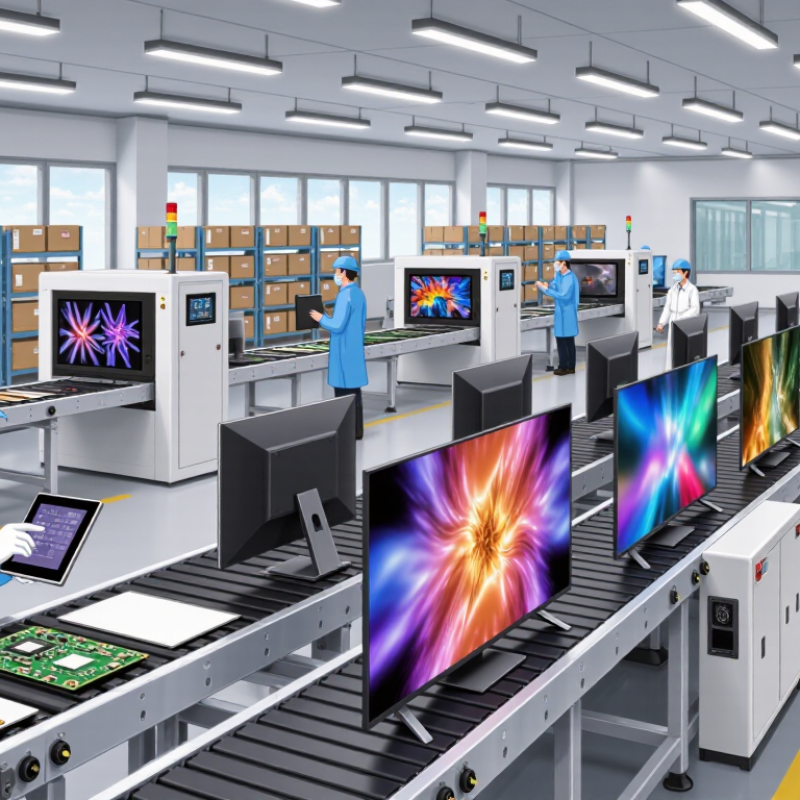
A display supplier earns trust through repeatable production, not impressive photos. In practical factory audits, manufacturing capacity means more than floor space. It includes trained operators, stable equipment, material planning, and realistic delivery schedules. A capable facility can move from prototype builds to larger orders without losing process control. That transition often exposes hidden weaknesses.
Small details matter. Incoming panels should be checked for brightness, color consistency, dead pixels, and physical damage. During assembly, calibrated tools help control bonding pressure and connector placement. Production teams can use first-article approval, in-process inspections, and final functional testing. Each batch should carry traceable records, including component lots, inspection results, and rework history. This creates evidence instead of vague promises.
Quality management must also cover long-term performance. Aging tests can reveal flicker, uneven illumination, heat-related faults, and unstable touch response. Samples should be tested under conditions that resemble actual use. No factory is flawless. A missed inspection step can still happen, especially during urgent orders. The important question is whether the supplier identifies the cause, corrects the process, and verifies the improvement. Capacity is valuable only when quality remains controlled at every production stage.
Market Position Compared with Other Display Suppliers
Calling one display supplier the “best” depends on the buyer’s project, not a slogan. Market position becomes clearer through measurable performance. A capable Chinese supplier may compete strongly through customization, production scale, and responsive engineering support. These advantages matter when a product needs a special size, narrow bezel, or sunlight-readable panel. Sample testing should cover brightness, color consistency, touch response, and operation across temperature changes. Requesting inspection records can reveal more than a polished sales presentation.
Large international suppliers often offer mature global service networks and extensive product libraries. Smaller manufacturers may respond faster to design changes and lower-volume orders. Price alone misleads. A low quotation can hide tooling fees, unstable component sourcing, or limited after-sales support. Buyers should compare warranty terms, production capacity, delivery history, and quality-control procedures. Independent audits, traceability records, and clear corrective-action reports provide stronger evidence of reliability. Ask for real data.
From a sourcing perspective, factory communication is equally important. Engineers who explain technical limits usually create fewer surprises later. A supplier should also provide sample approval steps, packaging details, and a practical escalation process. Yet no supplier is perfect. A fast response does not always mean strong long-term service, and impressive samples may not represent mass production. Buyers should review several shipments, inspect random units, and record recurring defects. That evidence may change the market ranking entirely.
Is Disen Electronics China Best Display Supplier? - Market Position Compared with Other Display Suppliers
| Evaluation Dimension | China-Based Mid-to-High-End Display Supplier | Global Tier-1 Display Manufacturer | Specialized Regional Supplier | General-Purpose Trading Supplier |
|---|---|---|---|---|
| Primary market focus | Industrial equipment, medical devices, automotive displays, smart appliances, and embedded systems | Large-volume consumer electronics, automotive, industrial, and enterprise applications | Specific industrial, commercial, transportation, or professional equipment niches | Standard commercial panels and price-sensitive replacement projects |
| Common display technologies | TFT LCD, IPS, high-brightness LCD, projected capacitive touch, resistive touch, and selected OLED products | TFT LCD, OLED, Mini LED, AMOLED, automotive-grade displays, and advanced touch solutions | TFT LCD, IPS, sunlight-readable LCD, touch panels, and ruggedized display assemblies | Commodity TFT LCD modules and standard touch-enabled panels |
| Typical size coverage | Approximately 2.4–15.6 inches, with selected larger custom solutions | Approximately 1–100+ inches, depending on product division and end market | Approximately 3.5–32 inches, usually concentrated in defined application ranges | Approximately 2.8–15.6 inches, mainly standard catalog sizes |
| Customization capability | High: mechanical drawings, cover glass, FPC, connector, firmware, touch parameters, and optical bonding options | High for strategic accounts, but project approval and tooling requirements are typically more formal | High within its technical specialty; customization may be limited outside standard platforms | Low to moderate; most offerings are based on existing catalog products |
| Typical brightness range | Approximately 250–2,000 cd/m², depending on indoor, outdoor, or sunlight-readable requirements | Approximately 250–3,000+ cd/m² across consumer, automotive, and industrial product lines | Approximately 400–2,500 cd/m², often emphasizing outdoor readability | Approximately 200–700 cd/m² for standard indoor applications |
| Industrial temperature options | Commonly −20°C to +70°C; selected designs can support wider ranges after validation | Product-dependent; automotive and industrial lines may support approximately −40°C to +85°C | Commonly −20°C to +70°C; rugged models may support approximately −30°C to +80°C | Typically 0°C to +50°C or −20°C to +70°C, depending on the selected module |
| Interface flexibility | Common interfaces include RGB, LVDS, MIPI DSI, eDP, SPI, I²C, USB, and UART | Broad interface support with extensive system-level integration and validation resources | Good support for common industrial interfaces, with fewer platform choices than large manufacturers | Usually limited to the interfaces specified in the existing product datasheet |
| Quality and compliance expectations | Often supports ISO 9001-based quality systems, RoHS, REACH, CE, FCC, and application-specific testing | Usually maintains extensive automotive, medical, environmental, reliability, and traceability processes | Typically provides ISO-based quality management and compliance documentation for its target sectors | Documentation and validation depth can vary significantly by source and product batch |
| Prototype lead time | Typically 2–6 weeks for standard modules; longer when tooling or optical customization is required | Typically 4–12 weeks, with structured engineering and approval procedures | Typically 3–8 weeks, depending on the level of customization | Often 1–4 weeks when inventory is available |
| Mass-production lead time | Typically 6–12 weeks after engineering approval and material confirmation | Typically 8–20 weeks, influenced by allocation, forecast commitment, and production scheduling | Typically 8–16 weeks for customized products | Typically 2–8 weeks when products are already standardized or stocked |
| Relative cost position | Competitive total cost with better engineering support than purely price-led sources | Generally the highest cost, reflecting scale, validation, technology investment, and supply-chain systems | Mid-to-high cost, usually justified by specialized performance or regional service | Lowest initial purchase price, but potentially higher risk for consistency and long-term availability |
| Best fit for buyers | OEMs and integrators seeking customization, competitive pricing, and a balance between quality and responsiveness | Large programs requiring global support, advanced technology, high capacity, and extensive qualification | Projects requiring deep expertise in a particular industry or environmental condition | Low-volume, short-term, replacement, or highly price-sensitive applications |
| Overall market position | Strong value-oriented option for customized industrial and embedded display projects | Leading choice for scale, advanced technology, global qualification, and long-term capacity planning | Strong choice when application-specific expertise is more important than broad product coverage | Suitable mainly when price and immediate availability outweigh customization and lifecycle support |
Note: The figures above are representative industry benchmark ranges for display suppliers and should be verified against the selected product specification, qualification plan, forecast volume, and supply agreement.
Key Factors for Choosing Disen Electronics as a Supplier
Choosing a display supplier requires more than comparing unit prices. IDC recorded 1.24 billion smartphone shipments in 2024, a 6.5% annual increase. This demand raises pressure on panel consistency, delivery schedules, and engineering support. A capable supplier should provide traceable test records, stable brightness data, color calibration results, and clear defect definitions.
Technical evaluation should begin with samples from different production batches. Check viewing angles, touch response, backlight uniformity, connector strength, and performance after repeated temperature changes.
DSCC’s 2024 OLED Shipment Report forecast strong monitor-panel growth, reportedly reaching about 1.84 million units in 2024. That growth makes capacity useful, but capacity alone proves little. Ask for monthly output, yield rates, aging-test methods, and backup component plans.
Experience also matters during design changes. A supplier should explain whether a modification affects firmware, tooling, power consumption, or mechanical fit. Request ISO 9001 evidence and applicable RoHS or REACH documentation. Independent inspection can verify the paperwork. I would not rely on polished samples alone. A spreadsheet can hide late engineering responses. Communication is often the weak point. Set response-time targets, sample-approval stages, and escalation contacts before signing. The best supplier may still make mistakes, so the real test is how openly those mistakes are measured, corrected, and documented.