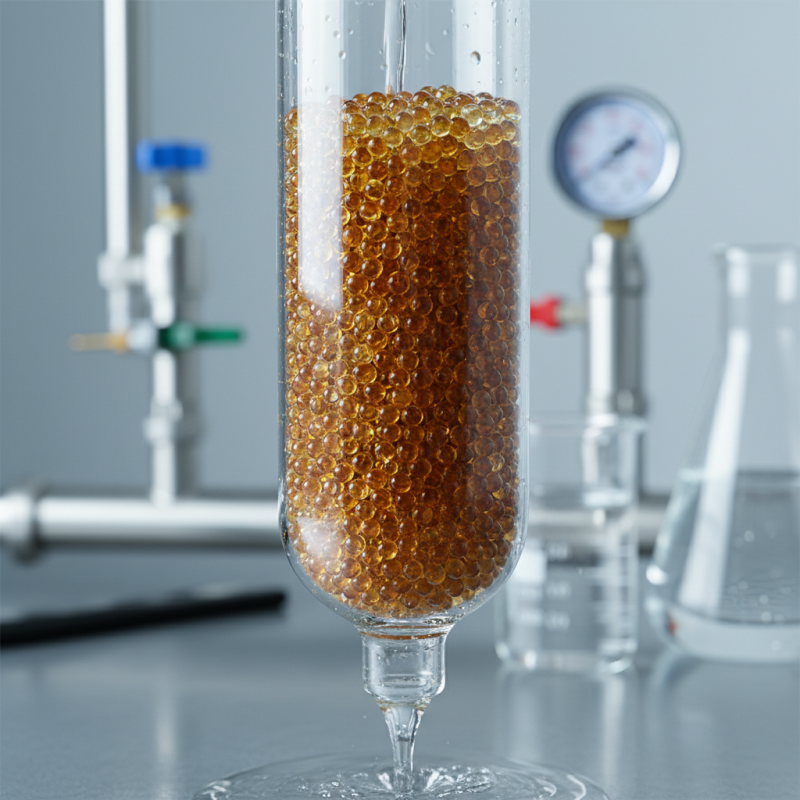
What is a strong base anion resin and how is it used?
strong base anion resin is a crucial component in water treatment processes. It helps remove unwanted contaminants from water. These resins are highly effective in neutralizing acids and bases, providing clean and safe water.
The strong base anion resin functions by exchanging ions with the contaminants. In this process, harmful ions are replaced with harmless ones. This helps maintain the desired water quality. It is widely used in industries like pharmaceuticals and food processing. However, the resin can degrade over time, necessitating regular checks and replacements.
Understanding its role is essential. A strong base anion resin can be a game-changer for many applications. But, user awareness is equally important. Improper use can lead to ineffective results. Thus, careful monitoring and effective management are critical.
Definition and Composition of Strong Base Anion Resins
Strong base anion resins are essential in water treatment. They consist of polymer beads that exchange hydroxyl ions for anions in water. These resins are often made from styrene-divinylbenzene. Their structure allows them to capture various anions efficiently.
The composition of strong base anion resins includes functional groups like quaternary ammonium. This gives them a high affinity for negatively charged particles. Production involves specific chemical processes. It might not always be perfect. Some resins can degrade over time, affecting their efficiency. Environmental factors also play a significant role in their performance.
Their applications are diverse, ranging from deionization to wastewater treatment. They remove contaminants effectively. However, the longevity of these resins can be an issue. Regular monitoring is crucial. Users must understand their limits. For instance, certain extreme conditions can lead to reduced efficacy. Observing performance trends can trigger better management strategies.
Mechanism of Ion Exchange in Strong Base Anion Resins
Strong base anion resins are crucial in water treatment processes. They work by exchanging negatively charged ions from the solution they process. These resins contain functional groups that attract anions like chloride, sulfate, and nitrate from the water. This exchange helps in removing impurities, making water safer for consumption and use.
The mechanism of ion exchange in strong base anion resins involves several steps. First, the resin is charged with hydroxide ions. When water passes through, undesirable anions replace these hydroxide ions. This leads to the formation of a higher purity water stream. During this process, the effectiveness of the resin depends on the concentration of ions in the solution. Sometimes, incomplete exchanges happen. This may leave some unwanted ions behind.
Tip: Regular regeneration of the resin is necessary to maintain its effectiveness. It's essential to monitor ion concentrations regularly. Make adjustments as needed. This continuous care will enhance the overall efficiency of your water treatment system. Remember, not all resins work the same. The choice depends on your specific needs and conditions.
Applications of Strong Base Anion Resins in Water Treatment
Strong base anion resins play a crucial role in water treatment. These resins are specifically designed to remove anions, such as sulfate, nitrate, and phosphate from water. They help to improve water quality by reducing contaminants. In industrial applications, these resins are vital for processes like demineralization. They effectively convert harmful substances into neutral salts.
Many studies highlight the efficiency of strong base anion resins. For instance, a report by the Water Research Foundation indicates that these resins can achieve over 90% removal of specific anions in contaminated water. This efficiency is essential for industries such as pharmaceuticals and food processing. Clean water in these sectors ensures product safety and compliance with regulations.
Tips: Regular maintenance of the resin is important. Resin replacement intervals can vary based on water quality. Monitor the resin's performance to prevent breakthrough contamination. Remember, not all resins perform equally. Testing can help identify the best resin for your specific needs. Anion resins can also interact with other treatment processes, complicating treatment efforts. Always consider the complete system when making decisions.
Applications of Strong Base Anion Resins in Water Treatment
Strong base anion resins are widely used in various water treatment applications. The chart above illustrates the distribution of applications where these resins are most commonly utilized, with water softening being the most significant application, followed by deionization and wastewater treatment.
Comparison with Other Types of Ion Exchange Resins
In the world of ion exchange resins, strong base anion resins stand out due to their specific applications. These resins are designed to interact with negatively charged ions, helping to remove contaminants from water. They are primarily used in water purification, ensuring that harmful anions do not remain in treated water.
When compared to other types of ion exchange resins, such as weak base anion resins, the differences become clear. Strong base resins effectively handle a wider range of anion types. They can remove sulfates, nitrates, and chlorides more efficiently. Weak base resins, on the other hand, function best with more limited anions, such as bicarbonates. This limitation can lead to less effective purification processes.
Despite their efficiency, there are challenges with strong base anion resins. Their performance can decline over time, necessitating frequent regeneration. This can be costly and time-consuming. Users must assess if the higher initial effectiveness justifies this operational complexity. It's essential to consider all factors when choosing the right resin for specific applications.
Maintenance and Regeneration of Strong Base Anion Resins
Strong base anion resins play a crucial role in various industrial processes. They are utilized for ion exchange, which helps in purifying water and removing unwanted ions. However, their efficiency can decline over time. Regular maintenance is essential to keep these resins performing optimally.
To maintain strong base anion resins, operators often conduct routine checks on the ion exchange capacity. Monitoring the pH levels and conductivity of the treated water is vital. If the efficiency drops significantly, it may signal that regeneration is necessary. The regeneration process typically involves flushing the resin with a strong alkali solution. This action helps restore the resin's ion exchange ability.
Maintaining these resins is not always straightforward. There might be missed steps in the maintenance routine. For instance, not fully rinsing the resin after regeneration can lead to performance issues. It’s crucial to reflect on these processes and refine them continuously. Learning from past experiences can improve the longevity and efficiency of strong base anion resins.
What is a strong base anion resin and how is it used? - Maintenance and Regeneration of Strong Base Anion Resins
| Property | Details |
| Definition | A type of ion-exchange resin that primarily exchanges anions. |
| Chemical Composition | High cross-linked polystyrene with quaternary ammonium functional groups. |
| Common Applications | Water treatment, deionization processes, and for the removal of contaminants like nitrates and phosphate. |
| Maintenance Frequency | Typically requires regeneration every few weeks to months, depending on the usage. |
| Regeneration Process | Utilization of sodium hydroxide for the regeneration of the resin's anion exchange capacity. |
| Advantages | Effective in removing strong acids, efficient regeneration process, long lifespan. |
| Limitations | May degrade in certain environments, limited anion exchange capacity after prolonged use. |