Top 10 Bathroom Basin Tap Types for Global Buyers
Choosing the right Bathroom Basin Tap now requires more than matching chrome with a countertop. Global buyers must evaluate water efficiency, installation standards, durability, user comfort, and regional design preferences.
The market is expanding. Fortune Business Insights reports that the global faucets market was valued at approximately USD 9.44 billion in 2023. It projects continued growth through 2032, driven by renovation, hospitality development, and smart-home adoption. Grand View Research also identifies premium finishes, touchless operation, and conservation technology as important market trends. These figures are useful, but they do not answer every purchasing question.
Water pressure varies greatly.
The World Health Organization and UNICEF reported that 2.2 billion people lacked safely managed drinking water in 2022. That reality makes responsible flow control more important. The U.S. EPA WaterSense program states that certified bathroom faucets use no more than 1.5 gallons per minute. They can reduce flow by at least 30% compared with standard models.
Hans-Jürgen Kalmbach, former Hansgrohe Group CEO, has emphasized, “Water is the most valuable resource on earth.” His statement gives practical meaning to product selection. A basin tap should conserve water without producing a weak, uncomfortable stream.
Still, no single model suits every bathroom. A tall mixer may look elegant beside a vessel basin, yet splash badly. A wall-mounted tap can save counter space, but installation becomes less forgiving. Some touchless models impress in hotels, while household users may find sensor delays frustrating.
This guide compares ten Bathroom Basin Tap types for international buyers. It considers performance, maintenance, compatibility, finish quality, and realistic installation conditions. The ranking is not absolute. Local standards and daily habits still matter.
Bathroom Basin Tap Basics and Classification Standards
Top 10 Bathroom Basin Tap Types for Global Buyers
Bathroom Basin Tap Basics and Classification Standards
Basin taps should be classified by installation, control, outlet design, and water function. The ten common types are single-hole, centerset, widespread, wall-mounted, deck-mounted, single-handle, two-handle, touchless sensor, thermostatic, and waterfall taps. These categories can overlap. A wall-mounted tap may also be single-handle or thermostatic, so product names alone can mislead buyers.
Installation dimensions matter. Check the basin’s hole spacing, counter thickness, supply connections, and spout reach before selecting a tap. EN 200 covers sanitary tapware for water supply systems in many markets. In North America, ASME A112.18.1/CSA B125.1 addresses mechanical performance and plumbing connections. These standards do not replace local approval requirements. That detail is often missed.
Water efficiency needs measurable evidence. The U.S. EPA WaterSense specification limits bathroom sink faucets to 1.5 gallons per minute, or 5.7 liters per minute, and states that certified models use at least 30% less water than standard 2.2-gpm faucets. Touchless and thermostatic models can improve control, but sensors, cartridges, and batteries add maintenance points. Water hardness also changes real-world performance. A technically compliant tap may still disappoint in a mineral-heavy home. Buyers should request flow-rate data, test certificates, replacement-part availability, and cleaning instructions. Classification is useful, but installation context decides whether the tap works well.
The 10 Main Basin Tap Types for Global Buyers
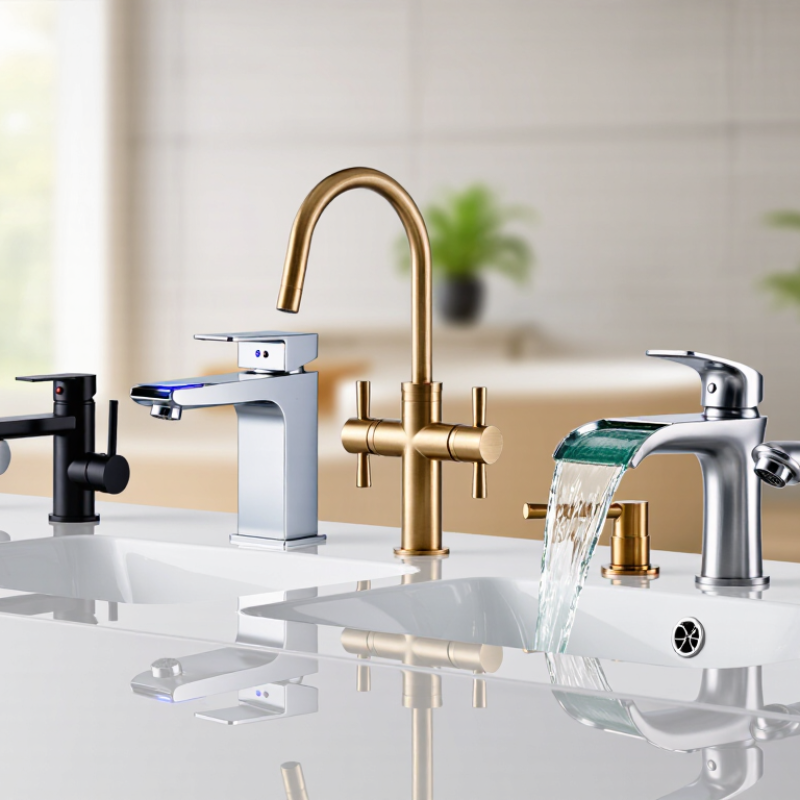
Global buyers usually compare ten main basin tap types: pillar taps, monobloc mixers, centerset taps, widespread taps, wall-mounted taps, bridge taps, vessel taps, waterfall taps, touchless taps, and thermostatic taps. Each design changes installation work, water control, and basin compatibility. Pillar taps suit separate hot and cold holes, while monobloc mixers need one central opening.
Centerset models fit compact, pre-drilled basins and simplify replacement. Widespread taps offer wider spacing for larger vanity tops. Wall-mounted taps create a clean surface, but their pipework must be planned before tiling. Bridge taps combine classic styling with a shared body. Vessel taps need extra height and a carefully sealed countertop opening. Waterfall outlets look distinctive, although their open flow can splash on shallow basins.
Touchless taps support hygienic public or residential settings and require reliable batteries or power. Thermostatic taps help maintain stable water temperature, which is useful in family bathrooms. In real projects, I check local connection sizes, pressure ranges, cartridge access, and certification requirements before selecting a model. A beautiful tap can still fail if its spout misses the drain or its handle hits the wall. I have seen this overlooked. Measure twice.
Finish, operating space, and cleaning access also matter. Brushed surfaces may hide fingerprints better, while smooth outlets need regular limescale removal. Water-saving aerators can reduce flow without making handwashing uncomfortable, but performance depends on pressure. Regional standards vary, so buyers should verify compliance with qualified installers and current local regulations.
Mounting Methods, Controls, and Operating Mechanisms
Bathroom basin taps differ by mounting method, control style, and internal mechanism. Deck-mounted options include single-hole, centerset, widespread, and vessel taps. Wall-mounted taps free the counter but demand accurate pipe positioning. A 2024 plumbing market review by Grand View Research identifies residential renovation and water-efficiency upgrades as major demand drivers, although market estimates vary by region.
Controls change daily usability. Single-lever taps offer quick temperature adjustment, while two-handle models provide finer flow control. Sensor taps reduce touchpoints, but they need reliable batteries or electrical access. Thermostatic controls can improve temperature stability, yet they may be unnecessary for a simple guest basin. Inside, ceramic disc cartridges usually provide smooth movement and fewer drips than older compression valves. Cartridge quality still matters. Installation errors remain common.
Tips: Check the basin’s hole spacing before selecting a widespread tap. Measure twice. Confirm spout reach, outlet height, and backsplash clearance. A short spout may splash against a deep basin. A tall spout may feel elegant but create more spray. The U.S. EPA WaterSense bathroom faucet specification limits flow to 1.5 gallons per minute, compared with the older 2.2-gallon federal maximum. This supports lower water use without forcing weak performance. The WHO and UNICEF Joint Monitoring Programme reported that 73% of the global population used safely managed drinking water in 2022. That figure does not make every faucet sustainable, but it highlights why flow control and repairability deserve closer attention.
Top 10 Bathroom Basin Tap Types for Global Buyers
Mounting methods, controls, and operating mechanisms
The chart compares typical installation and control configurations rather than market share. Single-hole and vessel mixers generally use one deck mounting point and one control input, while centerset and widespread taps commonly use three deck holes with two handles. Wall-mounted models use concealed plumbing instead of deck mounting. Touchless taps operate through an infrared sensor, thermostatic mixers regulate temperature through a thermostatic cartridge, and foot-operated taps use a floor or pedal valve.
Materials, Finishes, Standards, and Installation Factors
Choosing among the top 10 bathroom basin tap types requires more than attractive styling. Single-hole, centerset, widespread, wall-mounted, vessel, bridge, sensor, and thermostatic models suit different basin layouts. I have found that solid brass offers dependable weight and strength, while stainless steel resists corrosion in humid bathrooms. Zinc alloy can reduce cost, but its long-term durability may be less consistent.
Finishes affect both appearance and maintenance. Chrome is easy to clean and shows water spots quickly. Brushed nickel hides minor marks better. Matte black creates strong contrast, yet mineral deposits may become visible around the aerator. PVD finishes can improve surface resistance, but quality depends on the coating process. A beautiful finish is not automatically a durable one.
Global buyers should verify local standards for water safety, pressure, flow rate, and backflow protection. Requirements differ between regions, so a general compliance statement may not be enough. Check the product certificate and installation instructions carefully. Measure the basin hole spacing, deck thickness, supply connections, and available clearance below the counter. Wall-mounted taps need accurate pipe positioning before tiling. I once underestimated service access, and a small leak became unnecessarily difficult to repair. Flexible hoses simplify fitting, but they still need correct length and secure connections. Test temperature control, drainage clearance, and water flow before sealing the final fixtures.
How to Select a Basin Tap for Different Markets and Applications
Top 10 Bathroom Basin Tap Types for Global Buyers
Selecting a basin tap starts with the room, not the catalogue. Single-hole, centreset, widespread, and wall-mounted taps suit different basin layouts. Measure the tap-hole spacing before choosing a model. A beautiful fitting becomes useless when the water outlet misses the basin.
For compact apartments, a single-lever tap saves space and simplifies daily use. In hotels, sensor taps can improve hygiene and reduce water waste. They need reliable batteries or nearby power.
Public washrooms may require vandal-resistant construction and easy cartridge replacement. Traditional bridge taps suit renovation projects, but they usually need two holes and careful temperature adjustment.
Waterfall taps look striking, yet their open flow can splash on shallow basins. That detail is often missed.
Markets also differ in water pressure, pipe standards, and approval requirements. Low-pressure homes may need a tap designed for limited flow. Hard-water regions benefit from ceramic cartridges and removable aerators.
Healthcare and assisted-living projects should consider thermostatic control, lever access, and scald protection. Matte finishes hide fingerprints, while polished surfaces are easier to inspect for mineral deposits.
Check local testing marks, materials, warranty terms, and spare-part availability before ordering. I have seen projects focus heavily on appearance and overlook installation depth. That mistake is expensive. Sometimes, the safest choice is less fashionable.