Top 10 Oilfield Mud Pump Manufacturers Worldwide
Oilfield Mud Pump performance often decides whether a drilling operation moves smoothly or loses valuable hours. It circulates drilling fluid, removes cuttings, cools the bit, and supports well control. Dr. H. Rabia, author of Oilwell Drilling Engineering, describes the mud pump as “the heart of the drilling rig.” The phrase remains simple, but field crews understand its meaning immediately.
Industry demand is shaped by drilling activity, replacement cycles, deeper wells, and pressure requirements. The International Energy Agency’s World Energy Outlook 2024 shows a changing oil market, with demand growth slowing toward 2030. However, mature fields still require reliable equipment and frequent maintenance. Baker Hughes’ international rig-count reports also show how regional drilling activity can change month by month. These signals matter for manufacturers, but they do not tell the whole story.
Market studies from Grand View Research, MarketsandMarkets, and Fortune Business Insights report continued development across oilfield equipment and related service segments. Their estimates differ because product definitions and regional coverage are not identical. That limitation deserves attention. A pump selected only by price may create higher costs through liner wear, valve failures, vibration, or unplanned downtime.
This overview examines ten leading Oilfield Mud Pump manufacturers worldwide. It considers triplex and quintuplex designs, pressure capacity, power-end construction, pulsation control, service networks, spare-parts availability, and compliance with recognized industry practices, including API Spec 7K. Real performance still depends on application details. No ranking is perfect. Field conditions can change the result.
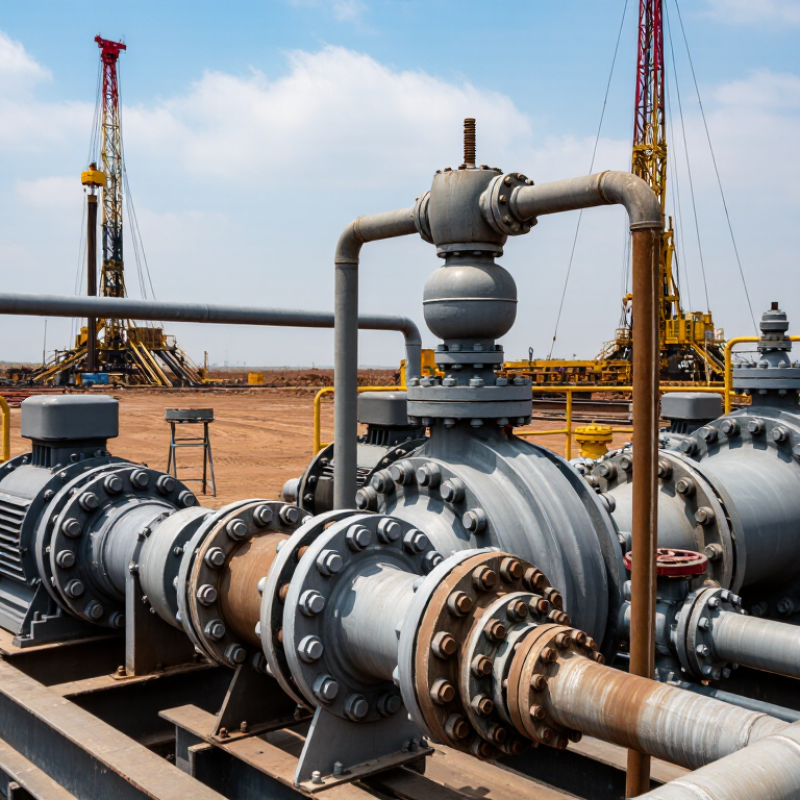
Definition and Role of Oilfield Mud Pumps
Oilfield mud pumps are high-pressure, positive-displacement machines that circulate drilling fluid through the well. They push mud from surface tanks into the drill string, across the bit, and back through the annulus. This flow cools the bit, carries rock cuttings upward, and supports wellbore pressure. The pump is not merely a fluid mover.
It is a pressure-control component.
Most modern rigs use triplex or quintuplex designs. Their pistons, liners, valves, and pulsation dampeners must work together under severe cyclic loads. API Spec 7K provides requirements for drilling and well-servicing equipment, while API RP 13D explains how mud rheology affects hydraulic performance.
Field engineers typically monitor discharge pressure, strokes per minute, liner condition, and suction stability. A small suction leak can create major vibration and reduce effective circulation.
Industry demand keeps this equipment relevant. The International Energy Agency’s Oil 2024 report projects global oil demand to reach about 105.4 million barrels per day by 2029. That outlook does not directly measure mud-pump sales, but it indicates continuing drilling and completion activity.
Market reports also commonly identify pressure rating, automation, and maintenance efficiency as key pump-selection factors. Yet a perfect spreadsheet can mislead. Actual performance changes with temperature, solids content, altitude, and operator habits.
A pump rated for high pressure may still deliver poor results when the liner is worn or the mud is poorly conditioned. Reliability begins with inspection, not advertising.
Key Criteria for Comparing Global Mud Pump Manufacturers
Comparing global mud pump manufacturers requires more than ranking horsepower or advertised maximum pressure. Capacity is not enough. According to the IEA’s Oil 2024 report, global oil demand may reach 105.4 million barrels per day in 2030. OPEC’s World Oil Outlook 2024 projects 112.3 million barrels per day by 2035. That outlook makes uptime, maintainability, and efficient hydraulics practical comparison points.
Check rated flow, discharge pressure, liner life, valve access, and power-end inspection intervals under the same operating assumptions. Ask for field failure rates, mean time between repairs, spare-part lead times, and documented test procedures. API Spec 7K alignment matters, but certification alone does not prove suitability for abrasive, high-solids drilling fluid. Look for traceable test records, calibrated pressure data, and evidence from comparable well sections. Service matters.
Lifecycle cost should include energy use, consumables, crew hours, transport, and downtime linked to pump failures. Manufacturers with regional technicians can reduce response delays, yet local coverage must be verified rather than assumed. A practical scorecard might assign 30% to reliability, 25% to service, 20% to lifecycle cost, 15% to compliance, and 10% to delivery. Those weights are not universal. Remote land rigs may prioritize parts availability. I would revise the score after interviewing operators; procurement assumptions are often cleaner than field reality.
Top 10 Oilfield Mud Pump Manufacturers Worldwide - Key Criteria for Comparing Global Mud Pump Manufacturers
| Rank | Manufacturer Profile | Pump Configuration | Rated Power Range
(hp) | Maximum Pressure
(psi) | Maximum Flow
(gpm) | Typical Stroke
(in) | API 7K Compliance | Drive Arrangement | Typical Application | Service Coverage | Comparison Score
(100) |
| 1 | Manufacturer Profile 01 | Triplex, single-acting | 1,300–2,200 | 5,000–7,500 | 1,200–1,800 | 12–16 | Yes | Mechanical power end | Deepwater and high-pressure drilling | Global | 94 |
| 2 | Manufacturer Profile 02 | Triplex, single-acting | 1,000–2,000 | 5,000–7,500 | 1,000–1,700 | 12–16 | Yes | AC or diesel-driven | Land rigs and offshore packages | Global | 92 |
| 3 | Manufacturer Profile 03 | Triplex, single-acting | 800–1,600 | 5,000–7,000 | 850–1,450 | 10–14 | Yes | Electric motor or VFD | Conventional onshore drilling | International | 90 |
| 4 | Manufacturer Profile 04 | Triplex, single-acting | 750–1,500 | 5,000–7,000 | 800–1,350 | 10–14 | Yes | Mechanical or electric | Mud-capable land rigs | International | 88 |
| 5 | Manufacturer Profile 05 | Triplex, single-acting | 600–1,300 | 3,000–5,000 | 650–1,150 | 8–12 | Yes | Diesel or electric | Medium-depth drilling | Regional and export | 86 |
| 6 | Manufacturer Profile 06 | Triplex, single-acting | 500–1,200 | 3,000–5,000 | 550–1,050 | 8–12 | Yes | Electric or hydraulic-assisted | Compact and mobile rigs | Regional | 84 |
| 7 | Manufacturer Profile 07 | Duplex or triplex | 400–1,000 | 3,000–5,000 | 450–900 | 8–12 | Yes | Mechanical power end | Workover and service rigs | Regional | 82 |
| 8 | Manufacturer Profile 08 | Triplex, single-acting | 350–900 | 3,000–5,000 | 400–800 | 6–10 | Yes | Electric motor | Geothermal and shallow drilling | Regional and export | 80 |
| 9 | Manufacturer Profile 09 | Duplex, double-acting | 300–800 | 2,000–4,000 | 350–750 | 8–12 | Yes | Mechanical or diesel-driven | Workover and well-servicing | Regional | 78 |
| 10 | Manufacturer Profile 10 | Triplex, single-acting | 250–700 | 2,000–4,000 | 300–650 | 6–10 | Yes | Electric or hydraulic | Light-duty and specialized drilling | Regional and export | 76 |
Note: Manufacturer names and brand-specific identifiers are intentionally omitted. Technical values are representative published specification ranges commonly used for comparing industrial oilfield mud pumps. Actual performance depends on liner diameter, operating speed, fluid density, pressure, configuration, and field conditions.
Leading Oilfield Mud Pump Manufacturers Worldwide
Leading oilfield mud pump manufacturers worldwide are judged by field performance, not catalog claims. A reliable pump must sustain high pressure, stable flow, and long duty cycles in abrasive drilling fluid.
Operators also examine liner life, valve access, vibration control, spare-parts availability, and service response near remote rigs.
Small design details matter. A poorly sealed fluid end can quickly become an expensive failure.
The International Energy Agency’s Oil 2024 report expects global oil demand to approach a plateau near 106 million barrels per day by 2030. OPEC’s World Oil Outlook 2024 projects demand reaching about 123 million barrels per day by 2050.
These forecasts suggest continued drilling activity, although equipment buyers face stricter efficiency and emissions expectations. Industry market reports also place oilfield services growth in the coming years, but their pump-specific estimates differ because definitions and regional coverage vary. That uncertainty deserves attention.
A practical worldwide ranking should therefore compare hydraulic efficiency, maximum working pressure, operating hours, maintenance records, and lifecycle cost. Manufacturers with strong engineering teams often provide better piston design, automated lubrication, and condition monitoring. Yet advanced features do not guarantee field reliability. Mud properties, crew training, and maintenance discipline can change results dramatically. Independent testing is still essential.
Technologies and Product Features Shaping Mud Pump Performance
Top 10 Oilfield Mud Pump Manufacturers Worldwide
Technologies and Product Features Shaping Mud Pump Performance
Mud pump performance now depends on more than horsepower. The IEA’s Oil 2024 report expects global oil demand to approach 106 million barrels per day by 2029, keeping drilling efficiency under pressure. Modern triplex and quintuplex pumps commonly support discharge pressures from 5,000 to 7,500 psi, depending on configuration. API Spec 7K remains an important reference for pressure-containing equipment and operational safety.
Hydraulic performance begins at the suction manifold. Larger fluid ends, improved valve geometry, and replaceable liners help maintain flow under abrasive conditions. Pulsation dampeners reduce pressure fluctuation, protecting standpipe components and measurement tools. Variable-frequency drives can adjust strokes per minute during connections, circulation, and well-control operations. Less wasted energy matters.
Digital monitoring adds another layer. Pressure sensors, vibration analysis, and liner-temperature tracking can reveal early wear before a failure stops drilling. SPE and IADC technical papers repeatedly link stable equivalent circulating density with better hole cleaning and reduced nonproductive time. However, data quality is often overlooked. A dashboard cannot correct a blocked suction strainer or poor maintenance record.
Field crews still inspect valve seats, fluid-end bolts, and discharge dampeners by hand. That detail remains decisive. I may overstate automation if human checks disappear. The best pump design balances pressure capacity, maintainability, noise control, and lifecycle cost, rather than chasing maximum output alone.
Selection Considerations for Drilling Contractors and Operators
Top 10 Oilfield Mud Pump Manufacturers Worldwide
Selecting a mud pump requires more than comparing discharge pressure and horsepower. The IEA Oil 2024 report forecasts global oil demand reaching 105.4 million barrels per day by 2029. This outlook may support drilling activity, but it does not justify buying the largest available unit. Contractors should match pump capacity with well depth, mud density, flow rate, and expected pressure cycles. API Specification 7K provides a useful baseline for equipment design, testing, and safety documentation. Verify certificates, fatigue records, spare-parts support, and service response before signing a purchase order.
Field crews should inspect the fluid end, liners, pistons, valves, and crankcase access. A pump rated for high pressure can still fail early under abrasive solids or poor lubrication. Real operating conditions matter. Ask manufacturers for performance curves at the planned mud properties, not only laboratory water tests. NPT history deserves attention too. A cheaper pump can become expensive after one unplanned rig shutdown. I would also question optimistic maintenance intervals. They often assume cleaner mud than the well will actually produce.
Tips: Build a three-year cost model. Include power use, consumables, overhauls, transport, and technician availability. Confirm whether local technicians can complete repairs within the contractor’s drilling schedule. Review vibration monitoring options and pressure-relief arrangements. Leave a practical margin above calculated demand, but avoid excessive oversizing. More capacity is not automatically better. Recheck the choice after pilot-hole data becomes available.